
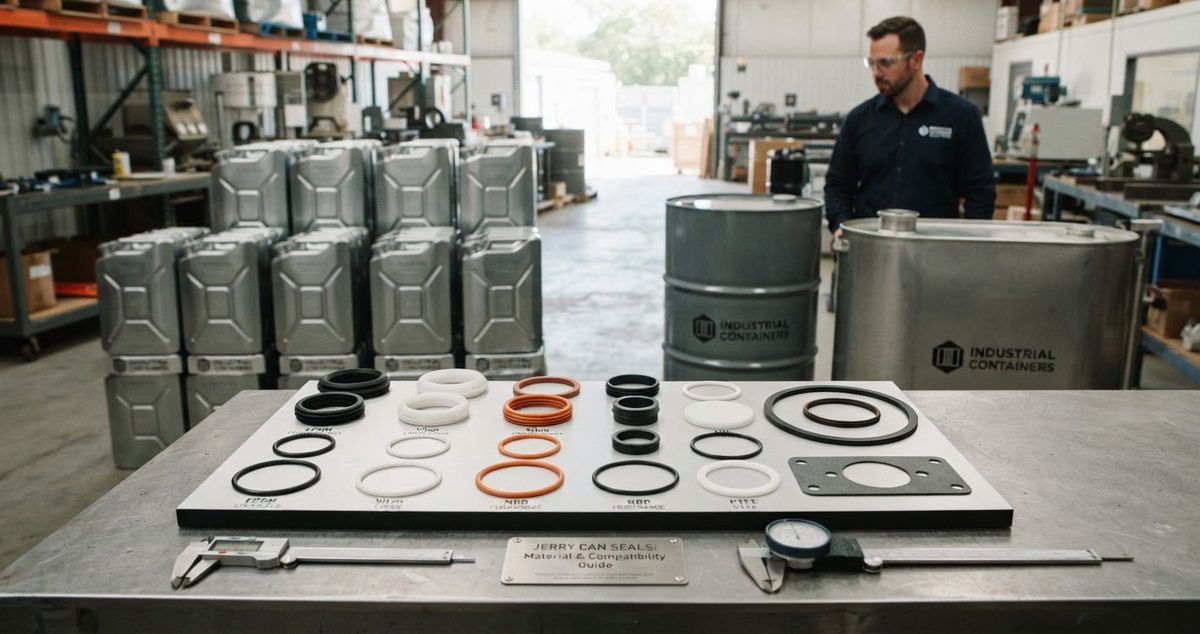
Procurement engineers should choose jerry can seals by matching the seal material to the liquid, the expected temperature range, and the closure design, then requiring evidence that the combination works. A seal that suits the container but conflicts with its contents can weaken containment; closure geometry also affects compression and fit. Start with the stored liquid and its handling conditions, define how the cap compresses the seal, and identify the tests or compatibility records needed for approval. This guide explains the decision criteria, compares material trade-offs by application, and sets out the evidence and dangerous-goods documentation to request before purchasing jerry cans or approving replacement seals.
How to choose jerry can seals for procurement
Begin with the liquid, then identify contaminants that may contact the seal. The contents might include cleaning agents, fuel residues, dust, water, or processing chemicals. Each exposure can change the seal’s condition, affect closure performance, or contaminate the product. Record the contents and the likely contaminants before comparing seal options.
Storage and transport conditions set the next requirements. Temperature changes, handling, stacking, vibration, and transport duration can alter compression and expose the seal to repeated movement. A seal that performs during short-term storage may not suit longer transport or rough handling.
Match the seal geometry to the jerry can neck and closure. The seal must sit in the correct position, compress evenly, and maintain contact without forcing the closure out of alignment. Excessive compression can complicate closing and replacement, while insufficient compression can allow leakage.
Approve a configuration that has been tested with the selected jerry can, closure, seal, and intended contents. Then compare chemical resistance, purchase cost, supply availability, and replacement needs. A lower unit price may lose its advantage if the seal is hard to source or requires frequent replacement. The best procurement choice is the tested configuration that protects the contents while keeping supply and maintenance practical.
Seal material trade-offs by application
Material selection for jerry can seals must match the liquid, closure design, temperature exposure, and test evidence. A polymer name alone does not establish a usable temperature range, chemical compatibility, compression performance, swelling resistance, or cost. Request the compound datasheet and test results for the exact formulation, rather than approving a seal from the base material alone.
| Material | Fuel and chemical compatibility | Temperature and compression considerations | Swelling risk and cost | Evidence required before approval |
|---|---|---|---|---|
| NBR | Screen against the named fuel, additives, and cleaning chemicals. | Require the compound’s temperature range and compression-set data. | Require immersion results and a supplier quotation for the selected compound. | Fuel-specific compatibility report, hardness, compression set, and dimensional-change results. |
| EPDM | Screen against the named liquid because suitability depends on the chemical exposure. | Require temperature and compression-set limits for the formulation. | Confirm swelling results and delivered cost for the required volume. | Chemical immersion data, temperature range, hardness, and compression-set results. |
| FKM | Require evidence for the actual fuel blend and additives. | Compare the compound’s temperature range and compression retention with service conditions. | Confirm measured dimensional change and total seal cost. | Fuel-specific test report, compound datasheet, and compression-set data. |
| Silicone | Poor default choice for gasoline, jet fuel, or diesel without compound-specific evidence. | Require fuel-exposure compression data, not temperature data alone. | A 2024 study measured swelling of 164% in ethanol-free gasoline, 157% in JP-5, and 113% in F-76 diesel. | Exact compound, immersion method, dimensional-change results, and compression-set data. |
| Polyurethane | Poor default choice for fuels without compound-specific evidence. | Require post-immersion compression and dimensional-retention results. | The same study measured 49–61% swelling in tested fuels; additively manufactured samples gained 110–120% mass after one week in military diesel. | Exact formulation, fuel exposure duration, mass and volume change, and compression-set results. |
Source: 2024 peer-reviewed study.
Why clean-fuel testing is not enough
A seal that survives clean reference fuel may respond differently after biodiesel oxidation, carbon contamination, lubricant exposure, ageing, temperature cycling, or extended immersion. These conditions can change swelling, hardness, tensile strength, and sealing force during service.
A 2025 study, Effects of Contaminated Biodiesel Dilution on the Seals of Automotive Systems, tested EPDM, chloroprene rubber, and NBR in B10 and B20 biodiesel blends for 900 hours. The researchers introduced carbon black and engine lubricant as contaminants and reported material degradation, with marked effects in NBR and EPDM, including increased swelling, lower tensile strength, and hardness changes.
Use those conditions as a qualification framework for jerry can seals. Test the actual elastomer compound, not a material name alone, against the fuel blend, contaminant exposure, immersion period, temperature range, and ageing profile expected in storage and transport. Record mass, volume, hardness, tensile properties, and dimensional change before and after exposure. Approve the seal when the tested compound retains the fit and sealing performance required by the closure under the defined service conditions.
Compatibility evidence for plastic jerricans
For plastic jerricans, ask for compatibility evidence that covers the complete packaging system, not only a generic seal-material chart. Elastomer charts compare seal materials against chemicals, but they do not establish whether a plastic jerrican wall will swell, develop stress cracks, or deteriorate when those effects combine.
ISO 17508:2025 provides a packaging-specific framework for that assessment. Published in October 2025 as its first edition, the 10-page standard specifies test methods for the chemical compatibility of packaging and intermediate bulk containers made from defined plastic constructions. Its scope covers plastic drums and jerricans used for liquid dangerous goods.
The evidence applies only to the material constructions and packaging types named by the standard:
- polyethylene (PE);
- fluorinated polyethylene;
- co-extruded plastics, including the two listed multilayer structures;
- IBC types 31H1, 31H2, and 31HZ1.
ISO 17508 therefore gives procurement engineers a stronger basis for evaluating fluorinated or multilayer jerricans, where wall compatibility can affect seal performance and container integrity. It does not turn a result for one construction into approval for every plastic jerrican. Match the test evidence to the specified PE, fluorinated-PE, or co-extruded construction before treating it as relevant to your jerry can seals. Generic elastomer charts remain a material-screening aid, not a substitute for this packaging-specific evidence.
What documentation to request before approving a seal
Your approval file should identify the exact liquid used in testing, along with the jerrican material, seal compound, seal geometry, and closure configuration. A generic compatibility statement or UN marking cannot show that the seal performed with your liquid and assembly. The UK Vehicle Certification Agency’s jerrican register links approvals to named test contents: certificate 6174 covers a 3H1 jerrican tested with ethylene glycol and water, while certificate 6398 covers one tested with water and antifreeze. The register lists certificate 6174 with the marking 3H1/Y1.4/100/**/GB/6174** and a revalidation year of 2028.
The test report should record closure torque or compression, test duration, test temperature, leakage results, and dimensional results. These details connect the seal’s performance to the production assembly rather than to a sample tested under unknown conditions. Design-test evidence should identify the tested package and closure, while change-control records should show whether later changes to the compound, profile, jerrican material, or closure affect that evidence.
Reference ISO 16495:2022 in the request. ISO identifies this edition as the current test-method standard for dangerous-goods package design testing; it replaces the withdrawn ISO 16495:2013 edition. Approve the seal only when the documents connect the specified seal and closure to the tested liquid and package.
Gasket requirements and dangerous-goods compliance
For Pakistan-market purchases, set the acceptance criteria against the buyer’s intended liquid, transport route, and applicable local dangerous-goods requirements. The closure specification should cover the gasket, cap, contact surfaces, tightening method, and the evidence required for leak performance. A gasket can support sealing, but its presence alone does not prove that a filled jerry can is leakproof. The complete closure assembly and the finished package must perform together.
For US exports, closure components become compliance-controlled parts of a specification packaging. A March 2026 PHMSA enforcement notice cites 49 CFR § 173.24(f)(2), which expressly includes gaskets and other closure components, and also references § 173.22(a)(4)(i). The notice requires the closure to meet the applicable packaging specification and follow the manufacturer’s closure information.
PHMSA Interpretation #12-0247 states that a jerrican can qualify as leakproof without a gasket when it passes the test in 49 CFR § 178.604. US export teams should also review § 178.601(c)(4) when a closure change affects design qualification. These US rules do not establish Pakistan-market requirements, but they show why procurement approval should assess tested closure performance rather than gasket presence alone.
Mehran Metal steel jerry cans and seal accessories
Mehran Metal supplies steel jerry cans in three capacities, with a fuel spout and rubber seal accessories. Procurement teams should match the closure set to the intended liquid and operating conditions before approval. The capacity identifies the container size, while the seal compound, dimensions, compatibility evidence, replacement route, and testing records determine whether the closure will remain suitable in service.
| Jerry can capacity | Supplied accessories | Fields to confirm |
|---|---|---|
| 5 litres | Fuel spout and rubber seal | Seal compound, dimensions, liquid compatibility, replacement availability, and testing documentation |
| 10 litres | Fuel spout and rubber seal | Seal compound, dimensions, liquid compatibility, replacement availability, and testing documentation |
| 20 litres | Fuel spout and rubber seal | Seal compound, dimensions, liquid compatibility, replacement availability, and testing documentation |
Approve the can and closure as one specification after these fields match the intended liquid and procurement requirements.
Q: Which seal works best for petrol or diesel?
A: Choose the seal whose material, dimensions, and compression suit both the fuel and the jerry can closure. Petrol and diesel can affect seal materials differently, so approve a seal only after reviewing compatibility evidence for the exact liquid and storage conditions.
Q: Is silicone suitable for jerry can seals?
A: Silicone may suit some applications, but its name alone does not prove fuel compatibility. Treat it as an option for testing, not as an automatic choice for petrol or diesel.
Q: Does every jerry can need a gasket?
A: No. The closure design and leak-control requirement determine whether the can needs a gasket. A threaded cap may use an integrated sealing feature, while another closure may rely on a separate gasket.
Q: How can procurement teams verify compatibility?
A: Match the seal material and compound to the liquid, temperature, closure pressure, and contact time. Review test evidence for the complete seal and closure assembly rather than relying on a material name.
Q: What documents should buyers request?
A: Request the seal drawing, material declaration, batch traceability, compatibility test report, and installation requirements. Keep the liquid’s safety data sheet with the approval record.
Q: When does a replacement seal require retesting?
A: Retest when the replacement changes material, dimensions, hardness, compression, or the closure design. Retesting also applies when the original qualification covered only the previous seal.
Request a jerry can and closure specification review
A sound seal choice starts with the container’s working conditions. Send Mehran Metal the liquid being packed, required capacity, closure arrangement, temperature range, handling conditions, and documentation required for approval. The review can connect those details with suitable jerry can seals and closure accessories before you place an order. Learn about Mehran Metal’s manufacturing background and review its hazardous-material drum range when your application involves regulated or hazardous liquids. Your specification should settle compatibility and documentation requirements before production begins.