
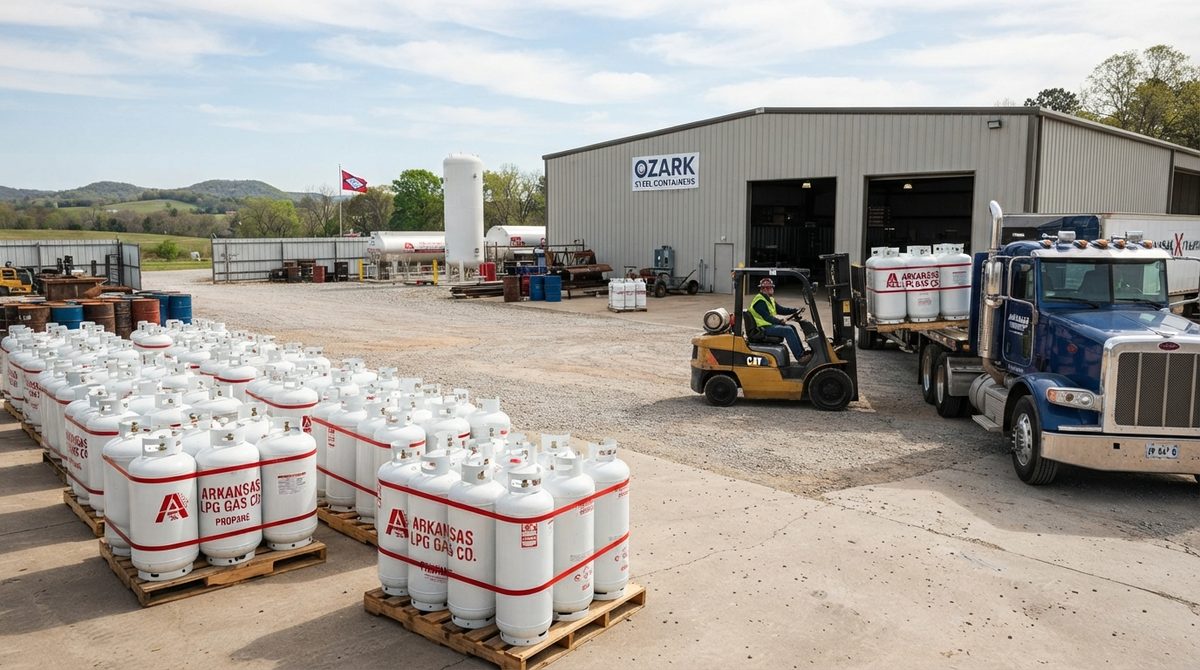
Choose a bulk lpg cylinder for Arkansas businesses when your operation needs a flexible supply that fits its demand, available space, delivery schedule, and refill routine. Choose a stationary bulk tank when the site can support fixed storage and regular bulk deliveries.
The right format affects more than capacity. Arkansas compliance requirements, vehicle access, separation distances, installation space, consumption patterns, and refill logistics can change the practical choice. This guide compares bulk cylinders with stationary LPG tanks, explains the specification and certification questions to raise, and covers transport, site planning, emergency controls, inspection, replacement planning, supplier resilience, and the buying checks that support a sound commercial decision.
A bulk LPG cylinder for Arkansas businesses suits sites that need modular storage and unit-by-unit handling. A stationary tank suits a facility planning a permanent installation with dedicated space. The choice also affects where you can store LPG: OSHA 1910.110 limits LP-gas storage inside an industrial building to 300 pounds, approximately 2,550 cubic feet of vapor, unless the facility uses a qualifying special room or building. A qualifying room can hold up to 10,000 pounds and requires 2-hour fire-resistant walls, floors, and ceilings.
| Decision factor | Bulk LPG cylinders | Stationary LPG tanks |
|---|---|---|
| Capacity | Adds storage in separate cylinder units as demand changes. | Provides a dedicated vessel for a planned storage volume. |
| Installation footprint | Works where a permanent tank foundation is difficult, subject to the site’s storage arrangement. | Requires space for a fixed bullet or spherical tank and its installation. |
| Portability | Individual units support movement and replacement within the approved handling plan. | Fixed equipment does not move with changing work areas. |
| Refilling | Uses a cylinder-by-cylinder replacement or refill process. | Uses a planned delivery and transfer arrangement at the tank. |
| Regulatory complexity | Indoor quantities quickly reach OSHA’s 300-pound threshold. | Requires tank design and installation against ASME, NFPA 58, and OGRA guidelines. |
| Best Arkansas fit | Facilities needing modular storage or facing limited permanent space. | Businesses with steady demand, outdoor space, and a permanent LPG installation. |
Cylinder sizes, specifications, and certification questions
For a commercial LPG cylinder order, Mehran Metal Containers lists a 45.4 kg cylinder as its commercial size. Its domestic range includes 2.0, 4.0, 6.0, and 11.8 kg cylinders. That distinction helps you match the cylinder to your operating demand instead of treating domestic units as a substitute for commercial supply.
The listed construction codes are DOT 4BA-270 for domestic cylinders and DOT 4BW-270 for the 45.4 kg commercial cylinder. Request the applicable approval documentation, cylinder markings, test records, and certificate copies with the quotation. The product information identifies a BAM-issued UN approval mark, a TUV Rheinland Product Safety certificate, and a GOST-R certificate. Verify that each document identifies the offered cylinder design and remains valid for your purchase.
Markings deserve close review when suppliers use metric and imperial units. NFPA 58-2024 TIA Log No. 1774 proposed allowing water capacity in pounds or liters and tare weight in pounds or kilograms for certain metric-marked cylinders. The proposal identifies a 2.2 factor between the relevant metric and English weight markings. Your receiving staff should therefore compare the marked water capacity, tare weight, design code, and certificate records rather than relying on the nominal kilogram size alone.
Ask the supplier to state the exact commercial cylinder size, design code, approval mark, certificate issuer, marking units, valve specification, inspection records, and documents supplied with each shipment. Those records give you a verifiable specification for purchasing, receiving, and future cylinder control.
Arkansas rules that affect commercial cylinder selection
For a bulk LPG cylinder for Arkansas businesses, use Arkansas’s adopted code editions as the starting point: NFPA 58, 2024 edition, for LP-gas systems and NFPA 54, 2024 edition, for fuel-gas installations. The Arkansas Liquefied Petroleum Gas Board adopted both standards effective July 2, 2026, subject to Arkansas-specific requirements under 15 CAR § 270-101. These codes shape whether the proposed cylinder system fits the intended installation and fuel-gas arrangement.
Federal code timing follows a separate track. On April 24, 2026, PHMSA published a direct-final rule that would replace its incorporated 2020 NFPA 58 reference with the 2024 edition. The intended federal effective date is January 1, 2027, unless adverse comments prevent that date. Arkansas’s July 2026 adoption therefore matters before the federal update takes effect.
Before buying, document the code basis for the complete cylinder package, not only the vessel. Match the supplier’s drawings, installation instructions, and certification records to the 2024 NFPA 58 and 2024 NFPA 54 editions, then screen the design against Arkansas modifications. A product that met an older NFPA 58 reference may require different documentation or installation treatment under the newer editions. This review should finish before you approve a purchase order.
Cylinder transport, storage, and valve requirements
For an Arkansas commercial installation, a cylinder over 40 pounds of propane that lacks an overfill prevention device (OPD) must have a POL plug during transport and storage. The plug closes the cylinder connection and helps prevent propane release when the service valve lacks OPD protection. This requirement affects handling as well as the storage decision, because a bulk LPG cylinder for Arkansas businesses may need compatible plugs and procedures before it reaches the site.
Arkansas’s 15 CAR § 270-124, DOT Cylinders, effective July 2, 2026, also requires replacement of valves requiring maintenance when they are 15 years old or older. Record the cylinder and valve age during receiving and inspection so an older valve does not remain in commercial service. Treat POL-plug compatibility, OPD status, and valve age as acceptance criteria before delivery.
Site planning for bulk LPG storage
For a bulk LPG installation in Arkansas, start with the container’s water-gallon capacity and draw the required separation distances on the site plan. Arkansas’s 15 CAR § 270-126 applies a 50-foot minimum to bulk-storage containers over 2,000 water gallons at commercial facilities and listed locations such as schools, hospitals, and cotton gins. The measurement runs to the nearest important building, group of buildings, or adjoining property line that may be built on.
The same rule sets a 50-foot clearance from railroad tracks and public highways. That distance can limit a site even when the storage vessel fits comfortably behind the building. A property line therefore needs review as a future building boundary, not only as today’s fence or paved edge.
Transfer storage near sensitive or crowded locations carries a larger separation: 400 feet from schools, hospitals, and public-assembly locations. That requirement can rule out a site where a bulk LPG cylinder or vessel would otherwise meet the building setback.
A waiver changes only the railroad or highway distance identified in the rule. After an approved waiver, the minimum becomes 25 feet, rather than 50 feet. It does not reduce the 50-foot building or buildable-property-line clearance, and it does not replace the 400-foot transfer-storage separation. The site plan must preserve the applicable distance before you commit to equipment or construction.
When bulkheads and emergency shutoffs are required
Arkansas requires a stationary LPG storage installation with 6,000 gallons or more of aggregate capacity to include bulkheads and emergency shutoff valves (ESVs) for both liquid and vapor transfer systems. This requirement applies to installations placed in service on or after July 1, 1993, under 15 CAR § 270-126.
The layout controls how the transfer connection reaches the shutoff. Arkansas limits the flexible braided hose between each ESV and the bulkhead to 24 inches. The bulkhead must stand 10 feet from the storage container, creating separation that helps protect the container and transfer equipment during an incident. Treat these dimensions as design constraints when comparing a bulk LPG cylinder arrangement with a larger stationary installation. A system below the 6,000-gallon aggregate threshold does not meet this specific trigger, although other site and fire-safety requirements may still apply.
Requalification, inspection, and replacement planning
For bulk LPG cylinders in Arkansas, schedule requalification according to each cylinder’s type, condition, and previous testing method. PHMSA’s Requalification Guidance for Propane Cylinders identifies these intervals:
- Five years: external-visual requalification
- Ten years: volumetric-expansion or proof-pressure requalification
A cylinder that fails visual inspection must leave refill service. An overdue cylinder also must not be refilled. Your replacement plan should therefore cover failed units and cylinders approaching their requalification date instead of waiting for an urgent refill request. Tie each cylinder’s identification, qualification date, testing method, and disposition to your inventory record so the next inspection or replacement trigger remains clear.
Use PHMSA’s Cylinder Requalifiers locator to find an approved provider for Arkansas operations. Enter a city, state, or ZIP code to review approved requalifiers, contact details, testing methods, and cylinder specifications. PHMSA references 49 CFR 107.805, 180.211, and 180.212 for approval requirements. The locator’s update-visibility target is approximately 1–2 business days. A provider approved for one testing method or specification may not cover every cylinder in your fleet.
Supply resilience and questions for your LPG vendor
Seasonal planning should treat local stock data as a warning signal, not a supply forecast. The U.S. Energy Information Administration reports Arkansas propane stocks at refineries, bulk terminals, and natural-gas plants at 15 thousand barrels in 2025, down from 40 thousand barrels in 2024, a 25-thousand-barrel decrease. That change gives procurement teams a reason to test delivery plans before peak demand.
Your vendor should define the delivery schedule, order lead time, emergency response process, and backup supply option in writing. Ask how the supplier handles a missed delivery and which party coordinates access, unloading, and installation work at your site. The vendor should also explain its support for cylinder requalification, inspection records, replacement planning, and shipment documentation. Those records help you track usable inventory and avoid delays when cylinders leave service.
A strong supply arrangement connects scheduled deliveries with documented backup capacity and installation coordination. That plan gives your Arkansas business a defined response when seasonal demand tightens available supply.
Bulk LPG cylinder buying checklist
| Field | Record before ordering |
|---|---|
| Capacity | Match each cylinder’s capacity to demand, handling limits, and available storage space. |
| Design code | Record the exact design code and confirm it suits the intended LPG service. |
| Approval evidence | Request approval documents, certificate numbers, and the issuing authority’s name. |
| Valve and overfill protection | Identify the valve arrangement and overfill protection included with each cylinder. |
| Marking | Check that permanent markings match the order, approval documents, and cylinder identity. |
| Inspection date | Record the latest inspection date and the next inspection requirement. |
| Quantity | Compare the number of cylinders with expected use, reserve needs, and delivery frequency. |
| Delivery | Confirm packaging, unloading equipment, delivery access, and handover responsibilities. |
| Site compatibility | Check storage layout, connection points, ventilation, vehicle access, and operating procedures before purchase. |
Q: What cylinder size suits an Arkansas business?
A: Choose the size that matches daily LPG demand, delivery frequency, available storage space, and the handling equipment at your site. A larger cylinder can reduce changeovers, but it also increases storage and site-planning demands.
Q: Should you use cylinders or a stationary LPG tank?
A: Cylinders suit businesses that need movable storage or staged replacement. A stationary tank suits a fixed site with steady demand and suitable space for permanent equipment. Compare delivery access, changeover time, expansion plans, and installation constraints before choosing.
Q: What Arkansas clearance checks apply to bulk cylinders?
A: Review the proposed cylinder location against the clearances required by the authority having jurisdiction, including distances from buildings, openings, ignition sources, property lines, traffic routes, and emergency access.
Q: Is a POL plug required?
A: Specify a POL plug when your cylinder, regulator, or hose connection uses that fitting. Matching the connection prevents incompatible equipment from entering service.
Q: When should cylinders be requalified?
A: Follow the requalification date and inspection markings on each cylinder. Remove any cylinder from service when its marking is unreadable, its condition is damaged, or its required inspection has expired.
Q: Can you store bulk LPG cylinders indoors?
A: Confirm indoor storage limits before placing cylinders inside a building. The decision must account for ventilation, ignition sources, occupancy, access, and the rules enforced at the Arkansas site.
Q: What documents should your LPG vendor provide?
A: Request cylinder specifications, approval and certification records, valve and connection details, inspection markings, handling guidance, and delivery documentation. These records let you match the equipment to the site and maintain a traceable replacement plan.
Request a commercial LPG cylinder specification review
A commercial LPG cylinder order should match your required capacity, application, site conditions, certification requirements, and delivery plan. Share those details with Mehran Metal Containers (Pvt) Ltd for a supplier discussion. Established in 1990, the company manufactures LPG cylinders and LPG storage tanks. Mehran Metal Containers can review whether a cylinder or tank solution fits your Arkansas operation and identify the specifications your quotation should cover before ordering.